


The Cowichan Valley
The Cowichan Valley sits on the east coast of Vancouver Island between Nanaimo and Victoria, with Duncan at its centre and roughly forty minutes of highway to Nanaimo, fifty to Victoria. Five towns carry most of the moves into it: Duncan, Maple Bay, Cowichan Bay, Cobble Hill and Lake Cowichan.
The single-family benchmark price for the valley was $788,700 in July 2026, according to the Vancouver Island Real Estate Board, about one per cent above the same month a year earlier and a little under the board-wide figure of $794,500. That is one number for the whole valley, and the reason there is no separate figure for each town is worth understanding before you compare them.
People move here for space and for the working rural economy that comes with it, and they stay or leave on the strength of the commute. This page covers what the valley costs, how its towns differ, what health care and schools look like, and what tends to surprise people once they arrive.
Where is the Cowichan Valley?
The valley runs inland and south from Duncan, on the east side of Vancouver Island. Highway 1 is the spine. It enters from the north out of Nanaimo and leaves to the south over the Malahat toward Victoria, and most journeys in the valley use some part of it.
The ferry terminals sit outside the valley, and a Cowichan Valley address does not come with one obvious ferry. From Duncan, Duke Point is about forty minutes and Departure Bay about forty-five, both to the north. Duke Point is the closer of the two, and it is reached without crossing Nanaimo, which counts for more at a busy hour than the few minutes suggest. Swartz Bay is roughly seventy minutes to the south. Which one you use depends on where you are going rather than where you live.
The towns spread out from there. Maple Bay and Cowichan Bay are both inside about fifteen minutes of Duncan, Cobble Hill about fifteen, and Lake Cowichan about twenty-five minutes west on Highway 18. One consequence catches people out: Cobble Hill is closer to Victoria than to Nanaimo, which reverses the pattern for the rest of the valley.
Mill Bay and Shawnigan Lake sit south of Cobble Hill and are their own places rather than part of it.
What is it like to live in the Cowichan Valley?
The valley is farmland and working countryside with two small centres in it. Vineyards, small farms, forestry and the water are all still working parts of the economy, and the landscape shows it.
Duncan is the valley's only city, and a small one. It holds the hospital, the shopping, the regional district offices and the services the rest of the valley drives to. It is also the geographically smallest city in Canada, at about two square kilometres, which is why so much of the built-up area around it belongs to the surrounding municipality of North Cowichan and not to Duncan itself.
Away from Duncan the pattern changes quickly. Cowichan Bay is a working waterfront village. Maple Bay is quiet water and boats. Cobble Hill is acreages and small holdings. Lake Cowichan is a forestry town on a large lake. The valley is small enough to drive across in half an hour and varied enough that those five places do not feel like versions of each other.
What does it cost to buy in the Cowichan Valley?
The benchmark price of a single-family home in the Cowichan Valley was $788,700 in July 2026, up about one per cent year over year. The comparable board-wide figure across Vancouver Island was $794,500 in the same month, so the valley sits slightly below the Island as a whole. Both figures come from the Vancouver Island Real Estate Board's Home Price Index.
There is no separate published benchmark for any individual town in the valley. Duncan, Maple Bay, Cowichan Bay, Cobble Hill and Lake Cowichan all sit inside one reporting area, and the board states the reason plainly: areas with insufficient data do not generate statistics and are not included in the index. So a figure presented as the price of a house in one particular town is not coming from the board.
Two things follow, and both matter more than the number itself.
The single-family figures exclude acreage and waterfront properties. Those are exactly what the Cobble Hill and Cowichan Bay markets are built on, so the valley benchmark describes the market with those property types removed. Pricing an acreage or a waterfront home off it will mislead you.
Second, what actually moves prices is different in each town, and that is the useful question. Lot size and agricultural land status drive Cobble Hill. Whether a Maple Bay property is waterfront, has a view, or is set back drives Maple Bay. The village strip and the surrounding area behave differently at Cowichan Bay. Distance from services drives Lake Cowichan. Duncan is its own case: the same house costs meaningfully less here than in the larger centres either side, and buyers priced out of those centres arriving because of it is itself part of what moves the market.
Condominium and townhouse benchmarks are published board-wide only, not for the valley. In July 2026 those were $407,300 and $548,900 across Vancouver Island. Treat them as Island figures, because that is what they are.
The five town pages below carry what drives price in each.
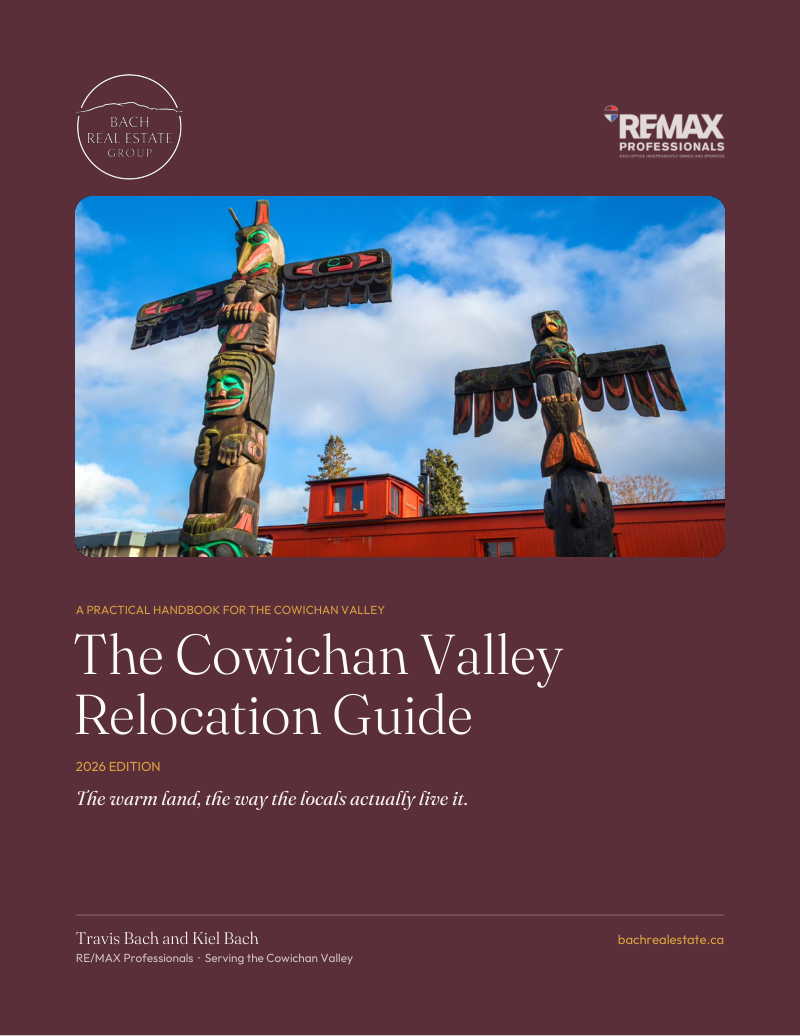
Click the guide below to download your copy.
 +5 more
All 6 guides, one download
The Cowichan Valley Relocation Guide, plus five more
- The 90-Day Relocation Checklist
- Health Care on the Island
- Strata, Explained
- Which Mid-Island Community Fits You?
- What Comes First
All your guides on the Cowichan Valley in one place.
Which Cowichan Valley town fits you?
Five towns carry most of the moves into the valley. They run roughly north to south, then west.
Duncan is the valley's only city and its service centre. The hospital is here, so is the shopping, so are the regional district offices, and so are most of the jobs that are not on a farm or in the bush. It is a working town first, and it is where the rest of the valley comes to do things. What it is like to live in Duncan.
Maple Bay is on the water east of Duncan, on Sansum Narrows, and it is quiet in a way the highway corridor is not. Boats are the organising fact of the place. It is inside about fifteen minutes of Duncan, which is less distance from services than most people assume a waterfront address costs them. Genoa Bay is nearby and is its own community. What it is like to live in Maple Bay.
Cowichan Bay is a working waterfront village south of Duncan on the estuary, and it is the one place in the valley where you can walk to most of what you need. It is also the valley's main float home community, and a float home works differently from any other purchase here. What it is like to live in Cowichan Bay.
Cobble Hill is the valley's southern edge, and it is acreages and small holdings. It is the closest of the five to the Malahat and to Victoria, and the only one closer to Victoria than to Nanaimo. Land here brings wells, septic systems and agricultural land rules with it. What it is like to live in Cobble Hill.
Lake Cowichan is west of Duncan on Highway 18, at the lake, and it is a working town. It is the furthest of the five from everything except the water, and it is the last town with services before the roads west turn industrial. Youbou and Honeymoon Bay are further along the lake and are their own communities. What it is like to live in Lake Cowichan.
What is health care like in the Cowichan Valley?
The valley has one hospital, Cowichan District Hospital, in Duncan. It is the referral point for the whole valley, which is one of the practical reasons Duncan matters more than its size suggests. A replacement hospital is under construction.
What the valley does not have is a second hospital, so anything the Duncan site does not handle means travelling. Nanaimo Regional General Hospital is about forty minutes north from Duncan and the Victoria hospitals about fifty minutes south, which puts most specialist care within an hour of most valley addresses. From Lake Cowichan, add the drive to Duncan first.
Finding a family doctor is the question people actually ask, and it is a provincial problem, not a valley one. Start that search before you move.
What are the schools like?
Public schools across the valley are run by School District 79, Cowichan Valley, which covers all five towns as well as communities outside this page's area.
Most of the towns have their own elementary school. Duncan has several, along with the valley's secondary schools. Maple Bay, Cowichan Bay and Cobble Hill each have an elementary school, and Lake Cowichan has schooling in town across a wider grade range than the other four.
French Immersion is offered at the elementary level, including at École Cobble Hill Elementary and École Mount Prevost Elementary in Duncan.
Catchments are the part worth checking rather than assuming. The district assigns schools by address and publishes a school locator tool for exactly that purpose, so the reliable answer for any particular house is the one that tool gives for that address. Catchment boundaries also change, which is a second reason to check the address you are buying and not the town.
How do you get around?
Highway 1 is the spine of the valley and most journeys use it. Duncan sits on it, Cowichan Bay and Cobble Hill sit just off it to the south, and Highway 18 runs west from near Duncan to Lake Cowichan. Maple Bay is reached by road east from Duncan, not from the highway directly.
You need a car. That is the plain answer for four of the five towns and very nearly the answer for the fifth. Cowichan Bay village is walkable within itself and Duncan has a compact centre you can cross on foot, but the valley's services, schools and work are spread across a distance that assumes driving. A household running one vehicle here will feel it.
For travel off the Island, plan around the split between the two northern terminals and the southern one. Duke Point and Departure Bay are both roughly forty to forty-five minutes north of Duncan and sail to the Lower Mainland by different routes. Swartz Bay is about seventy minutes south and sails to Tsawwassen and the Gulf Islands. Nanaimo Airport is south of Nanaimo, so it is closer to the valley than the city centre is.
What surprises people about the Cowichan Valley?
How much water and trail there is. The Cowichan River runs from Cowichan Lake east through the valley to the sea, and the Cowichan River Footpath follows about twenty kilometres of it west from Duncan to Skutz Falls. The Cowichan Valley Trail runs the length of the valley as part of the Trans Canada Trail, and crosses the Kinsol Trestle, a timber railway trestle over the Koksilah River, about 187 metres long and 44 metres above the water. It was built in 1920, abandoned when the rail line closed in 1979, and reopened for the trail in 2011. Mount Tzouhalem and Maple Mountain rise above the valley floor close to Duncan and carry much of the local hiking and mountain biking.
How rural the services get, and how fast. Duncan has a hospital and full shopping. Twenty-five minutes west, Lake Cowichan does not, and the gap between those two facts is larger than the distance suggests. Wells and septic systems are normal outside the serviced areas, and they come with their own inspections and rules.
The commute is real in both directions. Being between Nanaimo and Victoria sounds like access to both, and it is, but forty minutes each way is still forty minutes each way. People who move here for the midpoint and commute daily to either end usually revise the plan.
The valley is not one market. A waterfront property at Maple Bay, an acreage at Cobble Hill and a house in Lake Cowichan are three different purchases with three different questions attached, and the single valley-wide price figure hides all of that.
Questions people ask before moving here
Where is the Cowichan Valley?
The Cowichan Valley is on the east coast of Vancouver Island, between Nanaimo and Victoria, with Duncan at its centre. Highway 1 runs through it from north to south, and the valley extends inland and west toward Cowichan Lake.
How far is the Cowichan Valley from Nanaimo and Victoria?
From Duncan it is about forty minutes to Nanaimo and about fifty minutes to Victoria, off-peak and rounded. Times from the other towns vary: Cobble Hill is closer to Victoria than to Nanaimo, and Lake Cowichan adds about twenty-five minutes to Duncan before either drive begins.
Which Cowichan Valley town is the most affordable?
The Vancouver Island Real Estate Board publishes one benchmark for the whole Cowichan Valley and none for its individual towns, because areas with insufficient data do not generate statistics. So there is no published figure that ranks the five towns against each other. What is useful instead is what drives price in each: lot size and agricultural land status at Cobble Hill, waterfront against view against set-back at Maple Bay, the village strip against the surrounding area at Cowichan Bay, distance from services at Lake Cowichan, and relative pricing against the larger centres at Duncan. Each town page covers its own.
Is there a hospital in the Cowichan Valley?
Yes. Cowichan District Hospital is in Duncan and serves the whole valley, and a replacement hospital is under construction. Care the Duncan site does not provide means travelling to Nanaimo, about forty minutes north, or to Victoria, about fifty minutes south.
Do you need a car to live in the Cowichan Valley?
For practical purposes, yes. Cowichan Bay village is walkable within itself and central Duncan can be crossed on foot, but schools, work, shopping and health care are spread across the valley in a way that assumes driving. A household running one vehicle here will feel it.
Where to go next
If you are weighing the valley against the rest of the mid-Island, the Nanaimo relocation guide and the Oceanside neighbourhood guide cover the two areas people most often compare it with.
If you already know the valley is the place and you are working out which town, start with the five pages above. Each one answers what it costs to be there, what it is like day to day, and what to check before you buy.
Travis and Kiel Bach are REALTORS® with RE/MAX Professionals on central Vancouver Island, and they wrote the Cowichan Valley guide set that goes with this page. It covers the move in more detail than a page can: a relocation guide, a ninety-day checklist, health care, strata, community fit, and what to do first. Get the Cowichan Valley guide set.