


Duncan
Duncan is a city of about two square kilometres in the middle of the Cowichan Valley, and it is where the rest of the valley comes to do things. The hospital is here. So is the shopping, the regional district, the courthouse and most of the work that is not on a farm or in the bush. The valley's single-family benchmark price was $788,700 in July 2026, and a house in Duncan generally costs less than the same house in Nanaimo or Victoria, which is most of why people end up looking here.
It is a working town with a forestry and fishing history and a long stretch of hard years behind it, and it has not been tidied into something else. The main street is a real main street. The highway runs through the middle of town and you notice it.
Duncan is also the geographically smallest city in Canada. That fact does more work than it sounds: the city limits stop almost immediately, so a great deal of what people call Duncan is actually the surrounding municipality of North Cowichan, and where the line falls changes your taxes, your services and sometimes your school.
What Duncan has that the rest of the valley does not
This is the section that explains why Duncan matters more than its size suggests.
The hospital. Cowichan District Hospital is in Duncan and it is the referral point for the whole valley. A replacement hospital is under construction. Everywhere else in the valley, health care means a drive to Duncan first.
The shopping. Duncan carries the valley's full-line grocery, hardware and big-format retail. Lake Cowichan, Cowichan Bay, Maple Bay and Cobble Hill all have something, and none has everything.
The public institutions. The regional district is based in Duncan, along with the courthouse and the main provincial offices for the area. Vancouver Island University runs a campus serving Duncan, which is the only post-secondary presence in the valley.
The secondary schools. Quw'utsun Secondary and Quamichan School are here, and students from across the valley come to Duncan for secondary years.
A farmers market. Duncan runs one, and it gives the downtown a weekend rhythm the rest of the valley lacks.
Where Duncan is, and what it is close to
Duncan sits on Highway 1 about midway between Nanaimo and Victoria. Off-peak and rounded, that is roughly forty minutes north to Nanaimo and fifty minutes south to Victoria over the Malahat. Both are inside a commuting range that people genuinely use, in both directions.
Cowichan Bay is ten to fifteen minutes south, Maple Bay ten to fifteen minutes east, Cobble Hill about fifteen minutes south and Lake Cowichan about twenty-five minutes west on Highway 18.
For the ferries, Duke Point is about forty minutes and Departure Bay about forty-five, both north. Duke Point is the closer of the two and reaching it does not mean crossing Nanaimo, which counts for more at a busy hour than the few minutes suggest. Swartz Bay is roughly seventy minutes south.
The midway position is the thing to test before you commit. Forty minutes each way is a real commute, and people who move here planning to drive to either end daily often revise that plan inside a year. Drive it at the hour you would actually be driving it, in both directions, before you buy.
Why Duncan costs less, and what that is doing to prices
The Vancouver Island Real Estate Board publishes a single-family benchmark price of $788,700 for the Cowichan Valley in July 2026, up about one per cent year over year. That is the valley figure, not a Duncan figure. The board does not publish a benchmark for Duncan, or for any of the other four towns: all five sit inside one reporting area, and the board does not generate statistics for areas with insufficient data. Condominium and townhouse benchmarks are published board-wide across Vancouver Island only, at $407,300 and $548,900 in the same month.
What the figures do show is the gap. The valley benchmark sits below the board-wide figure of $794,500, and further below what the same house costs in Nanaimo or on the Victoria side. That gap is the single largest thing shaping the Duncan market.
The reason is history plus position. Duncan grew as a working town on forestry and fishing, went through a long depressed stretch, and did not acquire the price floor that a resort town or a commuter suburb acquires. It sits between two larger centres with both in commuting range. So the buyer arriving today is frequently someone priced out of Nanaimo or Victoria who can still reach one of them, and that arrival is itself now part of what moves prices here.
Which means the useful question in Duncan is not which street costs more. It is how long the gap lasts, and what you are buying while it does.
For the valley-wide picture and how the five towns differ from each other, see the Cowichan Valley guide.
Six guides on the move, and this page is the short version of one of them.
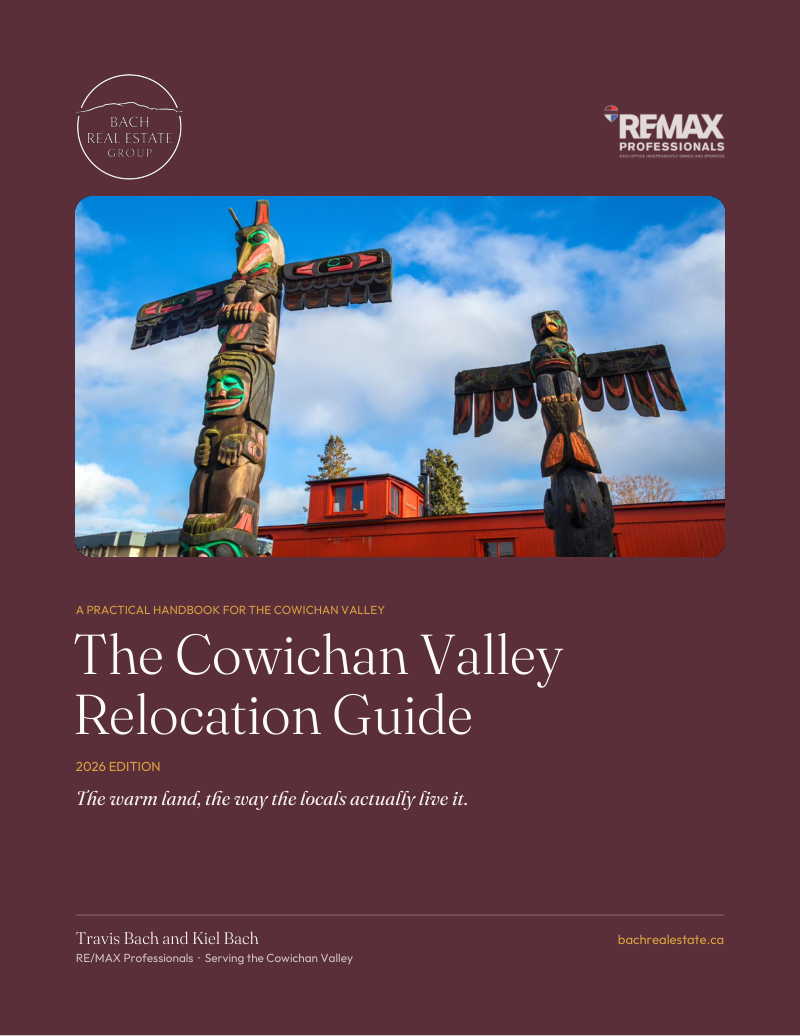 +5 more
All 6 guides, one download
The Cowichan Valley Relocation Guide, plus five more
- The 90-Day Relocation Checklist
- Health Care on the Island
- Strata, Explained
- Which Mid-Island Community Fits You?
- What Comes First
All your guides on the Cowichan Valley in one place.
The city, and the part that is not the city
Duncan proper is small enough to walk across. The downtown grid, the older streets around it and a short run of commercial along the highway are most of it. Housing there is older, lots are smaller, and you are within walking distance of the shops and the hospital.
Step outside those boundaries and you are in North Cowichan, the municipality that surrounds Duncan. It is a separate local government with its own council, taxes and services, and it holds most of what a newcomer would call Duncan: the newer subdivisions, the larger lots, the semi-rural properties on the slopes, and much of the retail. A listing described as Duncan is very often a North Cowichan address.
The practical differences are worth checking before you make an offer, because they are not visible from the street.
- Property tax rates are set separately by each local government.
- Water and sewer connections in the city, wells and septic systems on some properties outside it.
- Bylaws on suites, outbuildings and parking are written by whichever government you are in.
- Garbage, recycling and road maintenance run on different schedules.
Mount Tzouhalem rises east of town and carries much of the local hiking and mountain biking. Maple Bay is on the far side of it and is its own community.
Who moves to Duncan
Three groups, mostly.
People who want services within reach more than they want a view. Duncan is the practical choice in the valley. If being ten minutes from a hospital and a grocery store matters more than looking at water, this is the town that answers it, and it answers it for less money than the waterfront towns do.
Commuters, splitting both ways. Some drive north to Nanaimo, some south to Victoria, and the split is close to even. That is a function of the midway position, and it means Duncan is not a bedroom community for one city.
Buyers priced out of the larger centres. The gap between Duncan and either end is what brings most of them, and many arrive intending to commute and then find work locally.
What catches people out
The city boundary. Covered above, and it is the thing people most often miss. Two houses on the same road can sit in different jurisdictions.
The highway runs through town. Highway 1 is Duncan's main street for part of its length, which is convenient and noisy in equal measure. Properties close to the corridor are cheaper for a reason, and it is a reason you can hear.
Being a service centre is not the same as being a city. Duncan holds the valley's services and is still a small town. People arriving from a larger centre sometimes expect the range that goes with the word city. The trade is that everything is ten minutes away.
Schools are assigned by address. School District 79 covers the whole valley, and Duncan holds several elementary schools along with the valley's secondary schools. The district assigns catchments by address and publishes a school locator tool, so the reliable answer for a particular house is the one that tool gives for that address. Catchments also change. Check the house you are buying, not the town.
Questions people ask about Duncan
Where is Duncan, British Columbia?
Duncan is in the Cowichan Valley on the east coast of Vancouver Island, on Highway 1 about midway between Nanaimo and Victoria. It is the valley's only city and its service centre.
How far is Duncan from Nanaimo and Victoria?
Off-peak and rounded, about forty minutes north to Nanaimo and about fifty minutes south to Victoria over the Malahat. For the ferries, Duke Point is about forty minutes and Departure Bay about forty-five, both north, and Swartz Bay is roughly seventy minutes south.
Is there a hospital in Duncan?
Yes. Cowichan District Hospital is in Duncan and serves the whole Cowichan Valley, and a replacement hospital is under construction. Care it does not provide means travelling to Nanaimo or Victoria.
What does a house cost in Duncan?
The Vancouver Island Real Estate Board does not publish a benchmark price for Duncan on its own. Duncan and the valley's other four towns sit inside one reporting area, and the board does not generate statistics for areas with insufficient data. The published single-family benchmark for the Cowichan Valley was $788,700 in July 2026, and that is a valley figure. What shapes the Duncan market in particular is that the same house generally costs less here than in Nanaimo or on the Victoria side.
Is Duncan a good place to retire?
It suits people who want services close by. The hospital, the shopping and the public offices are all in town, most of it is flat enough to walk, and the valley's specialist care is either here or within an hour. What Duncan does not offer is a waterfront setting, which is what draws people to Maple Bay and Cowichan Bay instead.
Do you need a car to live in Duncan?
Less than anywhere else in the valley, and for most households still yes. Central Duncan is walkable and you can reach the hospital, the shops and the downtown on foot from the older streets. Outside that core, and for anywhere else in the valley, you are driving.
Where to go next
The other valley towns each answer a different question. Cowichan Bay is the walkable working waterfront ten minutes south. Maple Bay is quiet water and boats ten minutes east. Lake Cowichan is the working lake town twenty-five minutes west.
For how the five compare, and what the valley costs as a whole, start at the Cowichan Valley guide.
Travis and Kiel Bach are REALTORS® with Royal LePage Nanaimo Realty, working across central Vancouver Island. The Cowichan Valley guide set covers the move in more depth than a page can, including a ninety-day checklist and a plain-language look at health care and strata. Download the Cowichan Valley guide set.