


Most people ask this question as though the answer depends on the market. It does not. It depends on what you are uncertain about.
If you already know which street you want and the only open question is which house, renting first mostly costs you a year and two removal vans. If you are uncertain about the region, the town, or whether the whole idea holds up in February, renting is the least costly way to be wrong.
Here is how that actually breaks down, including one thing about this region specifically that catches people.
What does renting first actually buy you?
Time to be wrong cheaply. That is the whole product, and it is worth more than it sounds.
Buying commits you to a neighbourhood on the strength of a few visits, and a neighbourhood is the hardest thing to judge from outside. How it sounds on a weekday evening. Whether the walk to the shops is pleasant or just short. What the street is like in the wet season. Whether the commute you accepted on paper is one you can face at seven in the morning in the dark.
A rental year answers all of that from the inside, and if the answer is no, you move again instead of selling. That difference is the entire case for renting first.
It also buys you a proper look at the market. Not the market as a statistic, but the market as forty listings you have walked through, which is when people finally know what they actually want rather than what they thought they wanted.
What does it cost you?
Two moves, and a second round of every decision you were hoping to make once.
The obvious cost is money and disruption: two sets of moving expenses, possibly storage, and the general drag of living out of boxes for longer than planned. The less obvious cost is momentum. Households arrive with energy for this, and a year in a rental spends some of it. Some people never buy at all, which is fine if it was chosen and less fine if it was drift.
There is a smaller cost worth naming. Renting somewhere temporary means putting off the things that make a place feel like home, so the first year can feel provisional in a way that colours how you judge the region. Some people conclude they do not like it here when what they do not like is living in someone else's furniture.
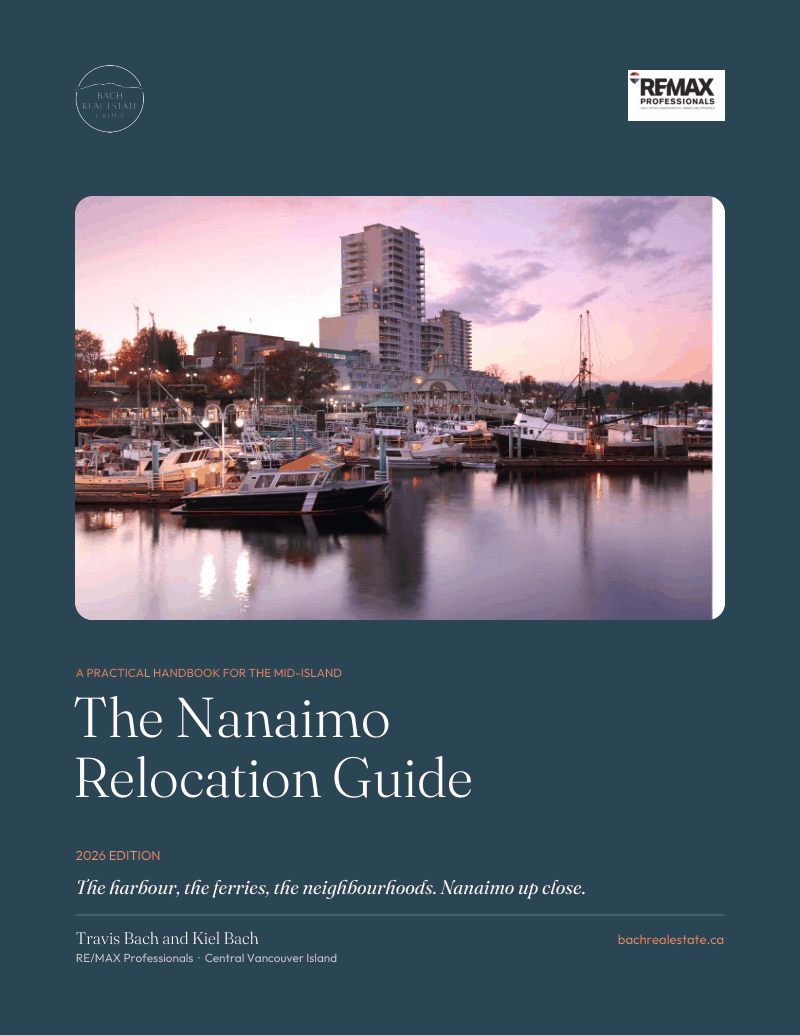
Click the guide below to download your copy.
 +5 more
All 6 guides, one sign-up
The full set covers the whole move, from the money to the neighbourhoods to settling in:
- Neighbourhood Guide
- Nanaimo 90-Day Checklist
- Equity & Cost of Living
- Health Care Guide
- Community Fit Guide
When is buying straight away the better call?
When the area is settled and the household is not.
If you already know the region, have visited in more than one season, and have narrowed to a town or two, the information a rental year would give you is information you already have. In that case renting mostly delays the thing you came to do.
It is also usually the better call when the household is unsettled in ways a rental will not help: children who need to start school somewhere and stay there, a pet that needs a garden, work that needs a permanent setup, or anyone for whom two moves in eighteen months is genuinely hard. Stability has a value that does not show up in the arithmetic.
And it is the better call for anyone who has already done the slow version. People who have holidayed here for years, or who lived here before, are not usually the ones who need a trial run.
The wrinkle specific to this part of the Island
This is the part that catches people, and it is the reason a general rule does not transfer here.
The rental stock and the purchase stock are not in the same places. Long-term rentals cluster where the density is: apartments, townhouses, and older housing in the more built-up parts of the city. The housing people move here to buy is often somewhere else entirely, on a quieter street, on a bigger lot, or out toward the semi-rural edges where almost nothing is available to rent long term.
So a rental year can put you in a part of the region you would never have bought in, and then you spend twelve months forming an impression of the area based on it. People do this and conclude the place is not for them, when what they actually experienced was one pocket of it that was never on their list.
There is a second version of the same problem. Seasonal and holiday stock is not the same as long-term rental stock, and a place that is easy to rent for two weeks in August can be hard to rent for a year. Anyone assuming a rental will be straightforward should check that assumption before building a plan on it.
If you do rent first, rent as close as you can to where you would actually buy, even if that means a compromise on the rental itself. A worse flat in the right area tells you more than a better flat in the wrong one. The neighbourhood guide is a reasonable place to work out which areas those are.
How do people actually decide?
In our experience it comes down to one question: what would you regret more, a year of renting you did not need, or a house you bought in the wrong place?
People answer that question differently and both answers are defensible. Someone who has moved several times and knows they adapt quickly will usually buy. Someone who has lived in one place for thirty years and is nervous about the whole enterprise will usually rent, and is usually right to.
A few practical tests that tend to settle it:
- Can you name the street? Not the town. If you can, you are probably ready to buy.
- Have you been here in February? If not, the uncertainty you are carrying is about the place, not the property, and a rental is the cheaper way to resolve it.
- Would a second move break something? School, work, health, or a person in the household who would find it genuinely hard. If yes, buying once is worth more than optionality.
- Is renting available where you would buy? Sometimes it is not, which settles the question for you.
Whichever way it goes, the running costs are worth understanding before you commit either way, and the cost of living page covers those.
Frequently asked questions
Should you rent before buying when you move to Vancouver Island?
It depends on what you are uncertain about. If you already know the town and the street, renting mostly delays the move and adds a second set of costs. If you are uncertain about the region or have never been here outside the summer, renting is the least costly way to be wrong about a neighbourhood.
What does renting first actually give you?
Time to judge a neighbourhood from the inside rather than from a few visits: how the street sounds on a weekday evening, what the walk to the shops is like, how the commute feels in the dark. If the answer is no, you move again instead of selling.
What is the downside of renting first?
Two moves, two sets of costs, and a second round of decisions you hoped to make once. It also spends some of the momentum a household arrives with, and living somewhere provisional can colour how you judge the region itself.
Is it hard to find a long-term rental on the central Island?
The harder problem is usually where the rentals are rather than whether they exist. Long-term rentals cluster in the more built-up parts of the region, while much of the housing people move here to buy sits in quieter areas or toward the semi-rural edges where little is available to rent long term.
How do you know if you are ready to buy straight away?
A reasonable test is whether you can name the street rather than the town, and whether you have been here outside the summer. If both are yes, a rental year is unlikely to tell you anything you do not already know. If a second move would break something for the household, buying once is usually worth more than keeping options open.
Thinking it through
This is a sequencing question rather than a market question, which means it is worth answering before you start looking rather than while you are looking. How to move to Vancouver Island covers the wider order of operations, and Moving to Nanaimo covers what living here is actually like. If you want to talk through which version fits your household, Travis and Kiel will tell you when the answer is rent first, and you can book a time.