


There is one route to a family doctor in British Columbia, and it is the Health Connect Registry. You register, an attachment coordinator contacts you when a provider in your area has capacity, and you cannot search for a doctor yourself through it.
What nobody will tell you is how long that takes, and that is not evasion. The province runs the registry, prioritises by medical need, and states plainly that it cannot estimate a wait.
So the useful version of this post is not a number. It is how the queue actually works, what decides your place in it, and what covers you meanwhile, because the meanwhile is longer than most people expect.
What is the Health Connect Registry?
It is the provincial route to being matched with a family doctor or a nurse practitioner, run by HealthLink BC. It is one of three registries inside the Provincial Attachment System, and it is the only one a member of the public interacts with.
Registering takes under five minutes, online or by calling 8-1-1. Phone registration is offered in more than 130 languages. You can register on behalf of family members or anyone in your care, and anyone living in BC without a provider is eligible.
You will need a Personal Health Number, which sits on a BC Services Card or a BC driver's licence, plus a home address, an email and a phone number. That requirement is the thing that catches people arriving from another province, and it sets the order of operations below.
How long is the wait for a family doctor?
Nobody publishes one. HealthLink BC states that it is unable to estimate how long you will wait, and neither Island Health nor the Ministry of Health publishes a figure for this region. There is also no published count of how many people on the central Island are without a provider.
That is worth understanding rather than working around, because the reason no single number could be accurate is built into how matching works.
Matching is not first come, first served. Attachment coordinators weigh three things: how long you have been registered, how many providers in your own community have capacity, and your age and health needs. People who need care most are prioritised, and HealthLink BC says directly that this affects how long everyone else waits.
Two consequences follow. Two neighbours who register on the same day can be matched years apart. And because provider capacity is assessed community by community, the wait genuinely differs by where you live, which is why a number from somewhere else on the Island would tell you nothing.
For scale, the province reports that more than 77 percent of British Columbians have a primary care provider and that roughly 4,000 more people are being connected each week. Those are province-wide figures, not central Island ones, and they should be read as direction rather than as a forecast for your household.
What order should a newcomer do this in?
The sequence is set by the system rather than by preference.
Medical Services Plan enrolment is mandatory and produces your Personal Health Number. The registry requires that number. So MSP comes first, and you can apply online, in person at a Service BC office, or by mail. The application covers MSP and PharmaCare together.
MSP coverage itself does not start immediately. New residents wait the balance of the month they arrive plus two further months. Arrive on any day in September and coverage begins on 1 December. Government advice is to keep your former province's plan running, or buy private cover, for that gap.
Apply for MSP the week you arrive, and register with the Health Connect Registry as soon as your Personal Health Number is in hand. Do not wait for coverage to start before registering if the number reaches you sooner.
What do you do while you wait?
This is the part that matters most, and there is more available than most newcomers realise.
Call 8-1-1
A nurse answers at any hour. Between 9 a.m. and 11 p.m. that nurse can connect you to a doctor by phone or video, with no referral, free with a BC Services Card. For a household without a provider this is the strongest single option available.
See a pharmacist
A pharmacist in BC can assess and prescribe for 21 minor ailments and for contraception, free, in person, with no family doctor involved. Covered conditions include uncomplicated urinary tract infections, allergies, pink eye and dermatitis. Bring your Personal Health Number and photo identification.
Use an urgent and primary care centre
These treat common illnesses and minor injuries, including coughs, colds, sore throats, ear infections, urinary tract infections, allergic reactions, skin conditions, stomach problems, sprains, strains and stitches. They are not for life-threatening emergencies.
- Central Nanaimo Urgent and Primary Care Centre, 3260 Norwell Drive, Nanaimo. Open every day, 8 a.m. to 8 p.m. Appointment only, no walk-ins. Book by phone.
- Medical Arts Urgent and Primary Care Centre, Unit 103, 650 South Terminal Avenue, Nanaimo. Weekdays 8 a.m. to 9 p.m., weekends 9 a.m. to 6 p.m. Appointment only. Call when the clinic opens, because the day fills quickly.
- Oceanside Urgent Care & Health Centre, 489 Alberni Highway, Parksville. Open every day, 7:30 a.m. to 9:30 p.m. Walk-in only, for urgent concerns, with laboratory and medical imaging on site.
Note the reversal there, because it catches people out: the Nanaimo centres take appointments and do not accept walk-ins, while the Parksville centre is walk-in only. Most people assume the opposite.
Find a walk-in clinic
There is no fixed list worth publishing, because clinic hours and availability change from one day to the next. The province points people at live tools instead: the BC Health Service Locator App, the HealthLink BC directory, and a Medimap walk-in search that shows current hours and estimated waits.
Other virtual services
Island Health lists free virtual options beyond the 8-1-1 route, including an after-hours pharmacist between 5 p.m. and 9 a.m., a 24-hour crisis line, chronic illness support, and Foundry for ages 12 to 24. Island Health also lists private virtual providers and states plainly that it does not operate, endorse or guarantee them.
Would a nurse practitioner do?
Yes, and this surprises people arriving from provinces where the role works differently. A nurse practitioner can be your permanent primary care provider. They diagnose, prescribe, order and interpret tests, and refer to specialists on their own authority.
The Health Connect Registry matches people to a family doctor or a nurse practitioner, so declining to consider one narrows your own options for no benefit.
Which central Island communities have a hospital?
Nanaimo Regional General Hospital, at 1200 Dufferin Crescent, has the emergency department for the central Island, open 24 hours.
Neither Parksville nor Qualicum Beach has a hospital, which is not the same as having nothing. The Oceanside Urgent Care & Health Centre in Parksville is a walk-in urgent care open every day, with laboratory and medical imaging on site, and it treats the common illnesses and minor injuries most clinic visits are about. What Oceanside does not have is an emergency department, so a life-threatening emergency means the drive to Nanaimo Regional General Hospital, the central Island's 24-hour ER. For anyone with an ongoing condition, that gap is worth weighing when choosing between Oceanside and Nanaimo.
Further out, Cowichan District Hospital in Duncan and West Coast General Hospital in Port Alberni both have 24-hour emergency departments. Ladysmith and Chemainus have health centres rather than hospitals, and Chemainus offers urgent care during opening hours only.
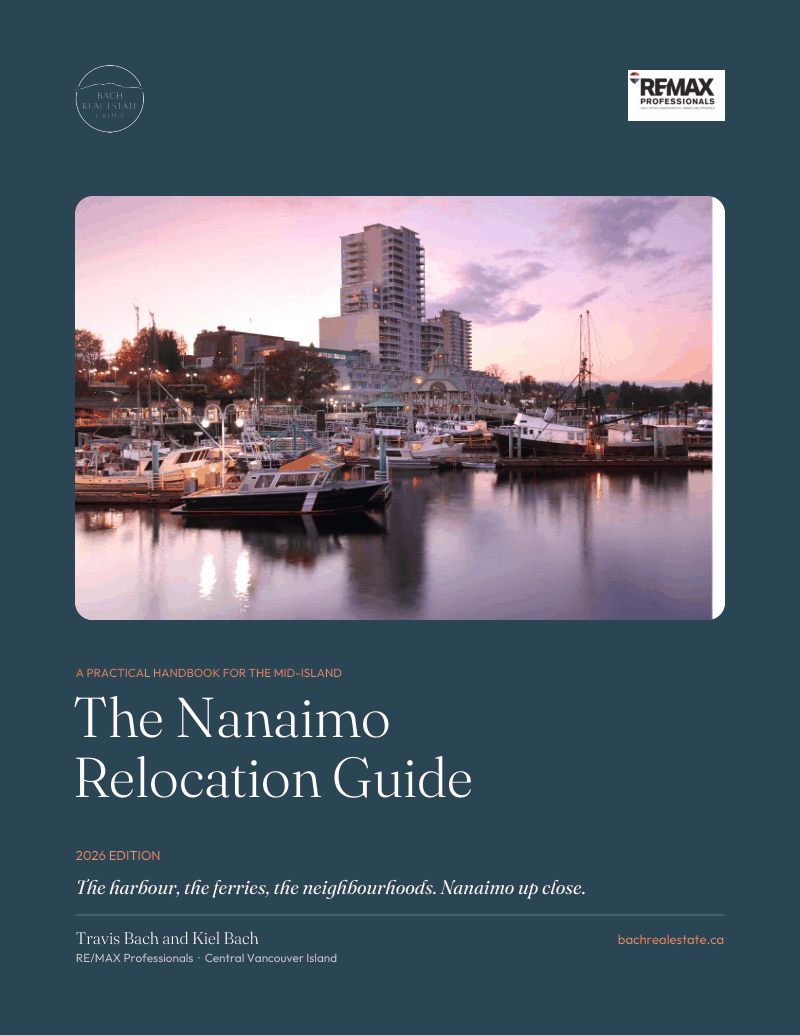
Click the guide below to download your copy.
 +5 more
All 6 guides, one sign-up
The full set covers the whole move, from the money to the neighbourhoods to settling in:
- Neighbourhood Guide
- Nanaimo 90-Day Checklist
- Equity & Cost of Living
- Health Care Guide
- Community Fit Guide
Frequently asked questions
How do you find a family doctor in Nanaimo?
Register with the Health Connect Registry, run by HealthLink BC. You can register online or by calling 8-1-1, and it takes under five minutes. An attachment coordinator contacts you when a provider in your area has capacity. You cannot search for a doctor yourself through the registry.
How long does it take to get a family doctor in BC?
No wait time is published, and HealthLink BC states that it is unable to estimate one. Matching is not first come, first served: coordinators weigh how long you have been registered, how many providers in your community have capacity, and your age and health needs. Two people who register on the same day can be matched years apart.
What do you need to register with the Health Connect Registry?
A Personal Health Number, which sits on a BC Services Card or a BC driver's licence, plus a home address, an email and a phone number. Anyone living in BC without a provider can register, including on behalf of family members or people in their care.
What can you do without a family doctor in Nanaimo?
Call 8-1-1 for a nurse at any hour, and between 9 a.m. and 11 p.m. that nurse can connect you to a doctor by phone or video, free with a BC Services Card. A pharmacist can assess and prescribe for 21 minor ailments and for contraception, free and in person. Urgent and primary care centres treat common illnesses and minor injuries.
Does Parksville or Qualicum Beach have a hospital?
Neither has a hospital, but Oceanside is not without care: the Oceanside Urgent Care & Health Centre in Parksville is a walk-in urgent care open every day, 7:30 a.m. to 9:30 p.m., with laboratory and medical imaging on site, treating common illnesses and minor injuries. What it does not have is an emergency department. For a life-threatening emergency the nearest is Nanaimo Regional General Hospital, open 24 hours; Cowichan District Hospital in Duncan and West Coast General Hospital in Port Alberni also have 24-hour emergency departments.
How long until MSP coverage starts when you move to BC?
New residents wait the balance of the month they arrive plus two further months. Arrive on any day in September and coverage begins on 1 December. Government advice is to keep your former province's plan running, or to buy private cover, for that gap, and to apply as soon as you arrive.
Working out whether the move works
Health care is the thing that stops more moves here than price does, and it deserves a straightforward answer rather than reassurance. The wider picture sits on Moving to Nanaimo, and the pros and cons page covers the other trade-offs people weigh. If you are working through timing, moving before school starts deals with the calendar side of it. Travis and Kiel can talk through how any of this lands for your household, and you can book a time for that.