
Most people who regret a move to the Island do not regret the Island. They regret the street, the house, the commute, or the timing, and those are considerably cheaper to fix than a region.
That distinction is worth sitting with before you decide anything, because the fear of hating it usually arrives as one large undifferentiated dread. Broken into its parts, most of it turns out to be manageable, and the part that is not is something you can test for in advance.
Here is what regret actually looks like after a move here, what undoing it involves, and how to lower the odds of needing to.
What do people actually regret?
When people tell us a move went wrong, the cause is almost always narrower than the place itself.
- The neighbourhood. A quiet street that turned out to be isolating, or a busy one that turned out to be loud. The region was fine; the pocket of it was wrong.
- The house. Bought for the view or the lot and found to need more upkeep than expected, a long drive from everything, or cold in a wet winter.
- The speed of the decision. A move made in four months after a decade of thinking about it, with the viewing trip squeezed into a long weekend.
- The season they judged it in. Everything was decided in August and the first November arrived as a surprise.
- What they left. Family and friends, which is a genuine loss and the one that does not have a property fix.
Notice that four of those five are about how the move was made rather than where it was to. That is the useful finding.
Why do the people who worry about this tend to be fine?
Because the worry makes them careful, and there is a pattern worth knowing. The people who arrive already asking what happens if they hate it are, on the whole, the ones it works out for.
The worry makes people careful. They visit in the off-season. They ask about the winter. They look at more than one area. They think about what they would do on an ordinary Tuesday. All of that is exactly what prevents the regret they are afraid of.
The moves that go badly are more often made by people who were certain, who fell for a place on holiday and never stress-tested it. Doubt, handled properly, is an asset.
What does undoing a move actually involve?
It is worth looking at directly, because the fear is usually of a trap, and the reality is a cost.
If the problem is the neighbourhood or the house, the fix is a move within the region. That is disruptive and it costs money, but it is an ordinary thing people do, and it is far less than starting over somewhere else. Budget for two sets of closing costs, including property transfer tax on the second purchase, and treat that as the price of learning the area properly. Plenty of people buy once, learn the region properly, and then buy again two or three years later in the place they would have chosen if they had known.
If the problem is the region itself, leaving is a larger undertaking, and it is the version worth avoiding. It is also the rarest version.
What makes either one less painful is having gone in knowing that a second move was possible, rather than treating the first purchase as permanent and final. People who give themselves that permission tend to make calmer first decisions, which makes the second move less likely.
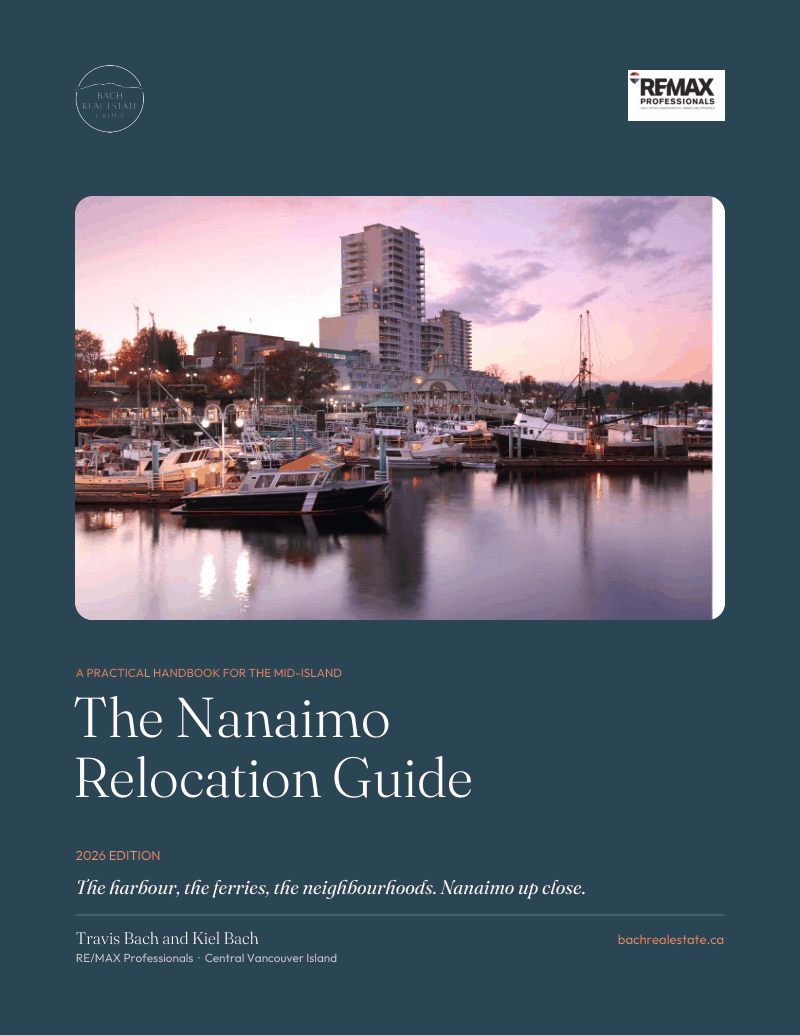
Click the guide below to download your copy.
 +5 more
All 6 guides, one sign-up
The full set covers the whole move, from the money to the neighbourhoods to settling in:
- Neighbourhood Guide
- Nanaimo 90-Day Checklist
- Equity & Cost of Living
- Health Care Guide
- Community Fit Guide
How do you test it before you commit?
You cannot remove the risk entirely, but you can shrink it a long way.
- Visit in February. One winter week tells you more than ten summers. The off-season is where the doubt usually lives, so that is where to test it. There is a fuller picture of the season in what winter here is like.
- Sleep where you would live. Stay in the neighbourhood you are considering rather than somewhere with a view. A week in a rental on an ordinary street in Departure Bay or Diver Lake tells you more than a week in a waterfront suite. Evenings tell you whether you could live somewhere; daytime only tells you about houses.
- Test your specific fear, not the general appeal. If you are worried about being bored, spend a wet weeknight there with nothing planned. If you are worried about distance from family, make the full journey home and time it properly.
- Consider a reversible first step. Renting for a year before buying costs you two moves, and buys you the chance to be wrong about a neighbourhood cheaply. Whether that suits you is covered in renting first or buying straight away.
- Budget a February, not an August. The costs that catch people after a move are the ones left off the spreadsheet, and the costs people forget when they move lists them.
- Read the downsides on purpose. There is a page on the downsides of living in Nanaimo for exactly this, and it is worth reading the cons first.
What if the answer is that it will not suit you?
Then finding that out before a purchase is the best result available.
Some people go through all of this carefully and conclude the Island is not for them, or not for them yet. That is not a failed process. It is the process working, and it is far better than reaching the same conclusion eighteen months after buying.
The only version genuinely worth fearing is the one where nobody asked the question at all.
Frequently asked questions
Do people regret moving to Vancouver Island?
Some do, but the regret is usually narrower than the place. Most of it traces to the neighbourhood, the house, a rushed decision, or judging the region only in summer. Those are cheaper to fix than the region itself, and most can be tested for before committing.
What happens if you move and do not like it?
If the problem is the neighbourhood or the house, the fix is a move within the region, which is disruptive and costly but ordinary. Plenty of people buy once, learn the area, and buy again a few years later where they would have chosen at the start. Leaving the region entirely is the larger undertaking and the rarest outcome.
How can you tell if you will like living somewhere before moving?
Visit in the off-season, stay in the neighbourhood you are considering rather than somewhere with a view, and test your specific fear directly. If you worry about boredom, spend a wet weeknight there with nothing planned. If you worry about distance from family, make the full journey home and time it.
Is renting first a good way to avoid regret?
Often, because it lets you be wrong about a neighbourhood cheaply. It costs two moves and a second round of decisions, so it suits people who are uncertain about the area more than people who already know exactly where they want to live.
Is it a bad sign if you are worried about hating it?
Usually the opposite. People who arrive asking the question tend to visit in the off-season, look at more than one area, and think about ordinary weekdays, which is exactly what prevents regret. The moves that go badly are more often made by people who were certain.
How long should you give it before deciding you made a mistake?
One full winter. Most of the doubt lives between November and February, and a decision made before you have seen one is a decision made on half the information.
Working through it before deciding
The most useful thing to do with this fear is to turn it into a list of specific things to test, then go and test them. If you want help designing a visit around the parts you are unsure about rather than the parts that already look good, Travis and Kiel are glad to plan that with you, and you can book a time. Moving to Nanaimo has the wider picture of what living here is like.