


Almost nobody decides to move here in one go. The usual shape is years of summers, a slow accumulation of the sense that the place fits, and then something specific that forces the question.
The decision rarely arrives on its own. Something external forces it.
Here is what the transition actually looks like, including the part where some people try it and go back.
How do people usually arrive at the decision?
Gradually, and then all at once. A common pattern is two weeks every August for years, then three weeks, then a month either side of it. Somewhere in there the arithmetic changes: people start counting how much of the year they are already here, and the number surprises them.
What tips it is usually external. A rental agreement they no longer want to renew. A retirement date that removes the reason to be anywhere else. A parent's health changing, or their own. Adult children settling somewhere on the coast. The wish to stay was there for years; the trigger just removed the reason to keep deferring.
For anyone already at the sharper end of that decision, owning here seasonally and weighing a first full winter, what changes when you stop leaving covers the narrower version.
That matters because it explains the timing pressure people arrive with. Years of thinking it over often turn into wanting it done in a few months.
What do people underestimate?
Three things.
How different the place is outside the season you know. If your entire experience of somewhere is July and August, you know one season of it. February is a different place. Some people find that a relief. Others find it a shock, and they had no way to know which they would be.
How much of the appeal was the holiday. Being somewhere with nothing to do and nowhere to be is a different experience from being somewhere with a dentist, a car insurance renewal and a leaking gutter. The place does not change. Your relationship to it does.
How long the practical side takes. Health coverage, a doctor, a driver's licence, insurance, banking, and the administrative tail of leaving one province for another. None of it is difficult. All of it takes longer than expected, and some of it cannot start until you are resident here: ICBC, for one, issues a B.C. driver's licence only to B.C. residents.
The first year-round winter
The first full winter, from the weather to what a summer property asks of you in January, has its own post: staying through winter.
What do people find better than expected?
The length of the good stretch, more than anything. Environment Canada's 1981 to 2010 climate normals for Nanaimo put the dry season from roughly late spring into October.
Beyond that, two things come up again and again. The size of the place: in Nanaimo most trips take about a quarter of an hour, and that changes how often you actually do things. And the outdoors stops being an outing and becomes a habit, because in Nanaimo the beach or the trail is about five minutes away rather than a planned weekend.
There is also something people rarely anticipate: knowing a place seasonally for years turns out to be a considerable head start. You already know the roads, the shops, the shape of the town. Newcomers with no history here spend the first year on that.
Who tries it and goes back?
Some do, and the reasons are narrower than the place.
The clearest pattern is distance from family. A move that made sense on paper stops making sense when the grandchildren are three time zones away and the visits turn out to be twice a year rather than monthly. That one is rarely about the Island at all.
The second is winter, specifically the light rather than the rain. Anyone who has spent decades in a place with cold bright winters can find the grey harder than they expected, and it is worth going in knowing that rather than discovering it in year one.
The third is a mismatch between the property and the life. A place bought for the summers, on a big lot at the end of a long driveway, is a different proposition in January when the driveway needs clearing of branches and the nearest shop is about twenty minutes away.
What the three share is timing. Each one shows up in the first winter or the second, and each one was visible before the move to anyone who went looking for it. What undoing a move involves, and how to lower the odds of needing to, is the subject of what if you move and end up hating it.
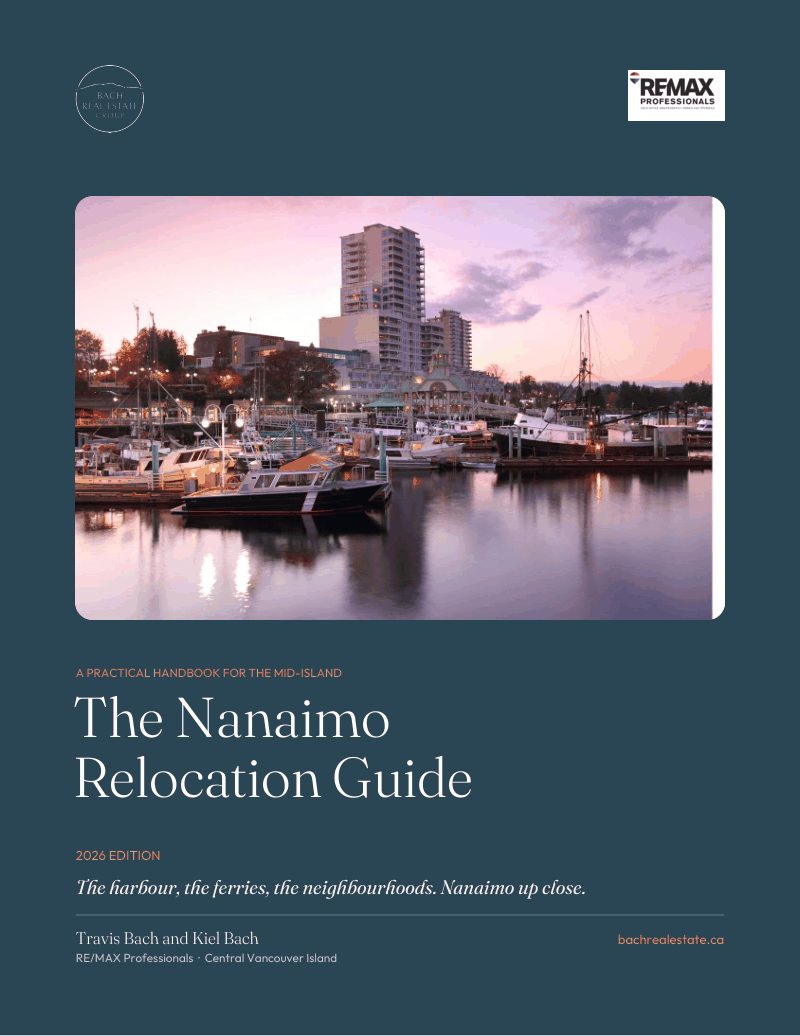
Click the guide below to download your copy.
 +5 more
All 6 guides, one sign-up
The full set covers the whole move, from the money to the neighbourhoods to settling in:
- Neighbourhood Guide
- Nanaimo 90-Day Checklist
- Equity & Cost of Living
- Health Care Guide
- Community Fit Guide
What makes the transition easier?
- Visit in the off-season before deciding. A February trip tells you more than ten Augusts.
- Start the practical side early. Health coverage in particular has a waiting period that does not begin until you arrive, under the Province's MSP rules.
- Think about the property in winter terms. Driveway, exposure, heating, how far to a shop. A summer place and a year-round home are not always the same house.
- Do not assume the town you holiday in is the town you should live in. Oceanside suits some people and Nanaimo suits others, and the difference matters more year-round than it does in August. The Oceanside Neighbourhood Guide and the Nanaimo Neighbourhood Guide set the communities side by side.
- Bring something to join. The people who settle fastest arrive with a reason to meet people that is not the weather.
Frequently asked questions
What is it like living on Vancouver Island year-round compared with visiting?
Quieter and greyer outside the summer, and the winter is the part a summer visitor has not seen. A February visit before deciding tells you more than another August.
What triggers the move from seasonal to permanent?
Usually something external rather than the decision itself. A rental agreement ending, a retirement date landing, a health event, or adult children settling within reach. The wish to stay is often years old, and the trigger removes the reason to keep deferring it.
What do people underestimate about moving here permanently?
How different the place is outside the season they know, how much of the appeal was the holiday rather than the location, and how long the practical side takes. Health coverage, a doctor, a licence, insurance and banking all take longer than expected, and some of it cannot start until you are resident here.
Is knowing a place seasonally an advantage when you move?
Yes, more than people expect. You already know the roads, the shops and the shape of the town, which newcomers with no history here spend the first year learning.
Working out whether it holds up year-round
The gap between loving somewhere in August and living there in February is the whole question, and it is a fair one to work through slowly. Moving to Nanaimo covers the practical picture. Take the Nanaimo Relocation Guide with you for the neighbourhoods and the numbers. If you are at the stage of testing the idea rather than acting on it, a call with Travis or Kiel covers what a full year looks like in the area you have been visiting, and you can book a time.